


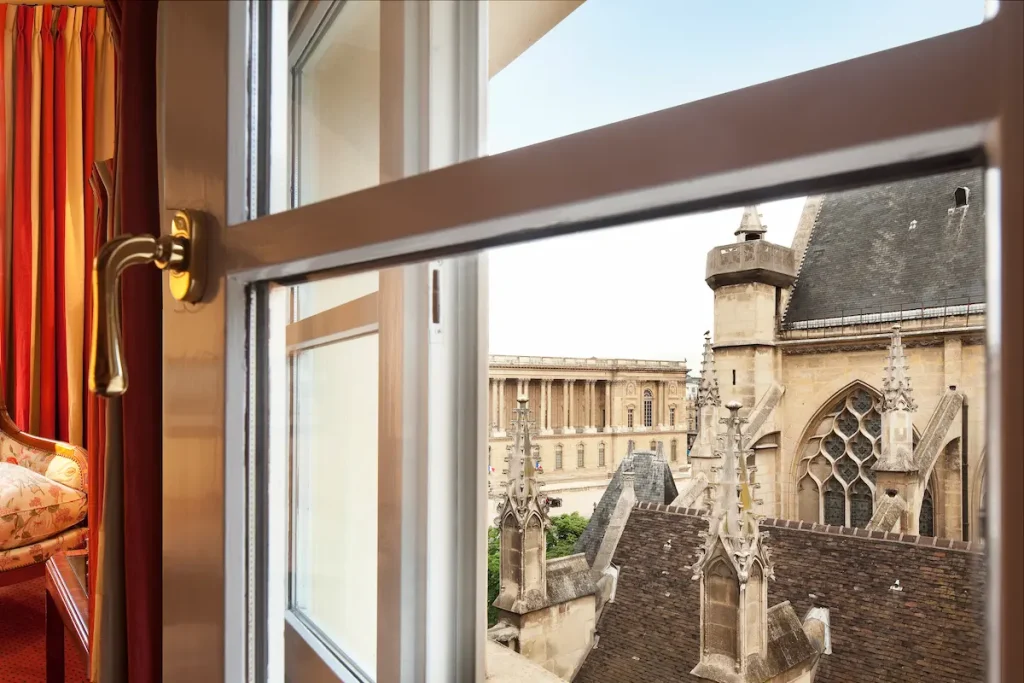
Opening the windows of Relais du Louvre offers a unique encounter with history. Originally built around 541 by Childebert, son of Clovis, the Church of Saint-Germain-l’Auxerrois stands with its stone lacework directly across from the hotel.
This fine building, witnessing fifteen centuries of evolution, was the appointed parish of the Kings of France, but also the starting point of a dark event that changed the fate of the country.
We highly recommend a visit. Follow us.
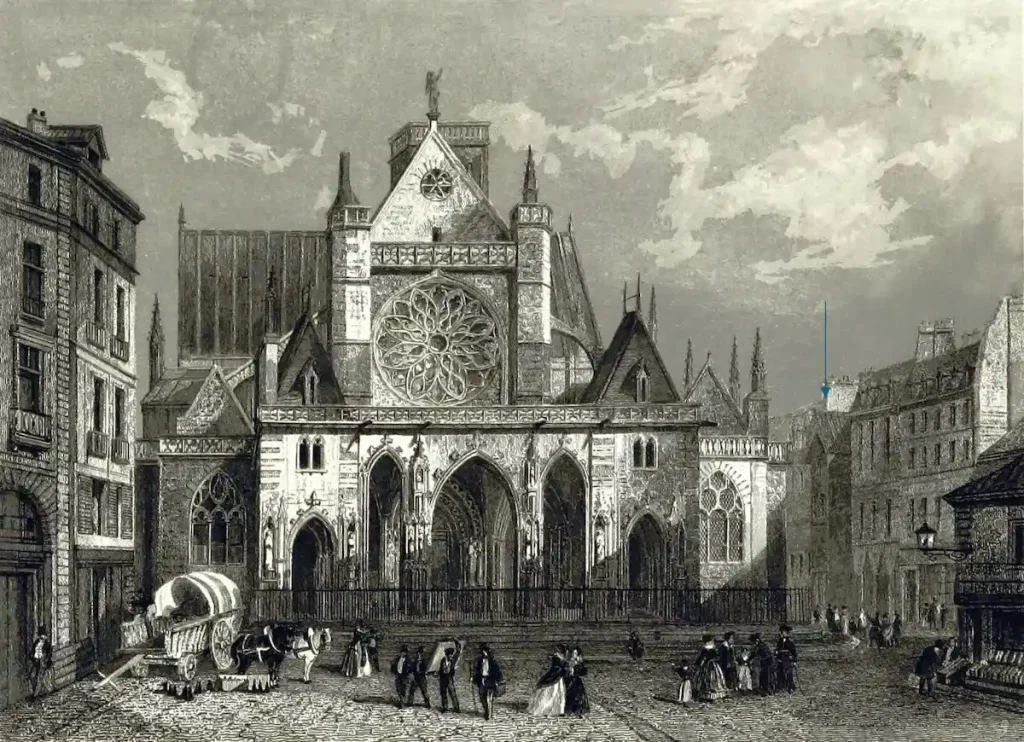
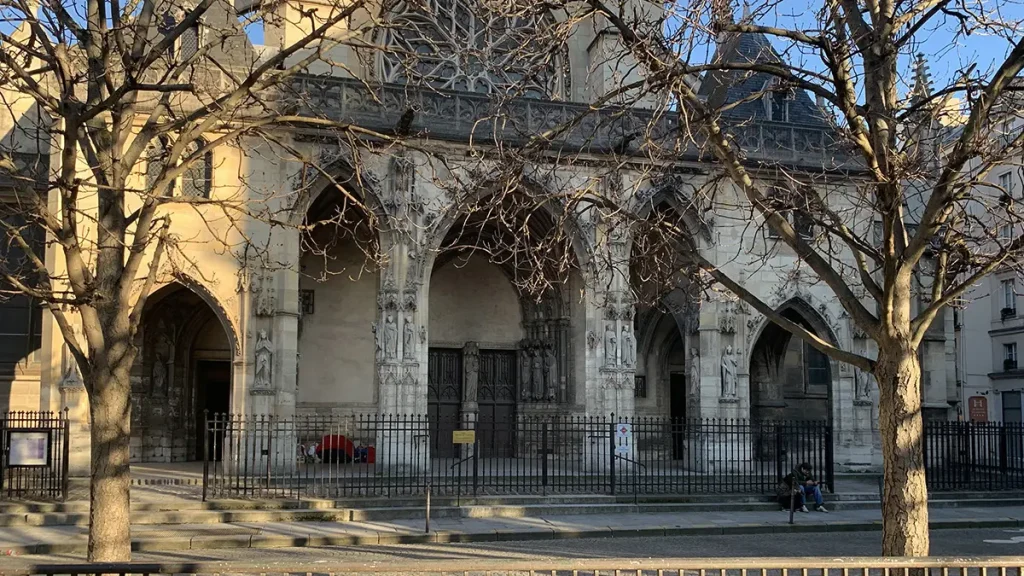
The arrival in front of the building is marked by its Flamboyant porch, built between 1435 and 1439. This five-arched porch is a rarity in Paris: it is here that Gothic art shows its final sparks before the Renaissance.
Unlike a classic porch, the one at Saint-Germain-l’Auxerrois is deep and elevated. During major religious festivals, the royal family could stand there to be seen by the people without being in direct contact with them. However, the sovereigns generally reached their parish through privileged access, and this monumental porch marked the solemn boundary between the royal residence and the sacred space.
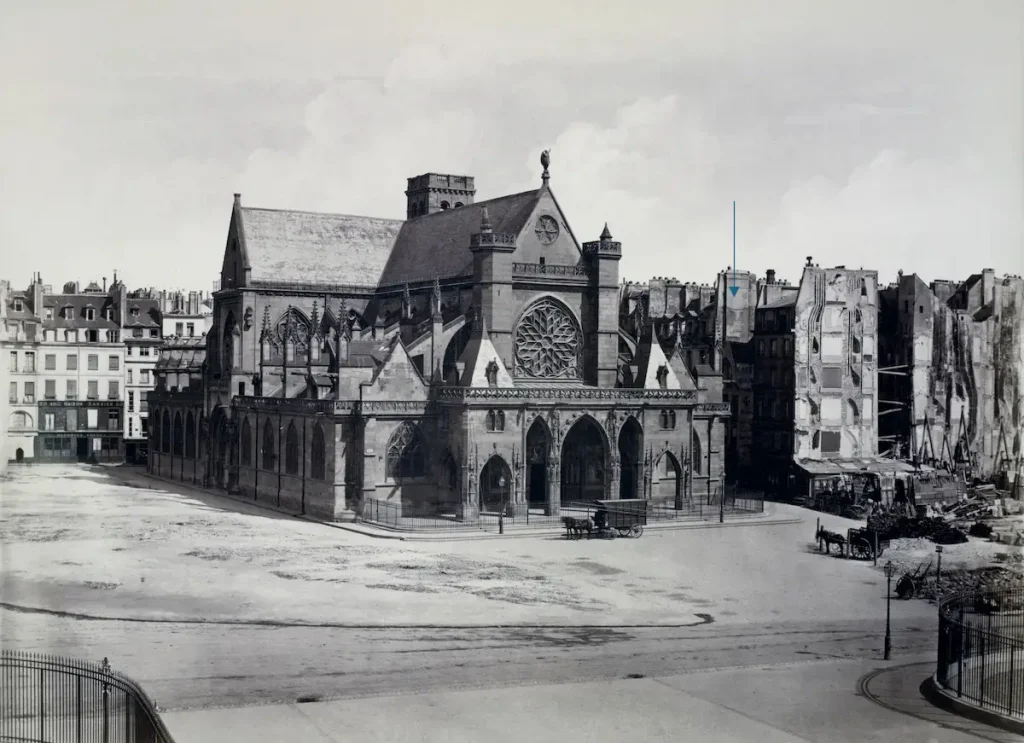
The current appearance of the square is the result of the major urban clearances of the 19th century. In this photograph by Édouard Baldus taken in 1856, we notice that the City Hall of the 1st arrondissement, now to the left of the church, is still absent from the landscape.
Above all, we see that the neighboring buildings, including the one that today houses the Relais du Louvre, narrowly escaped the massive demolitions linked to the enlargement of the square initiated by Baron Haussmann.
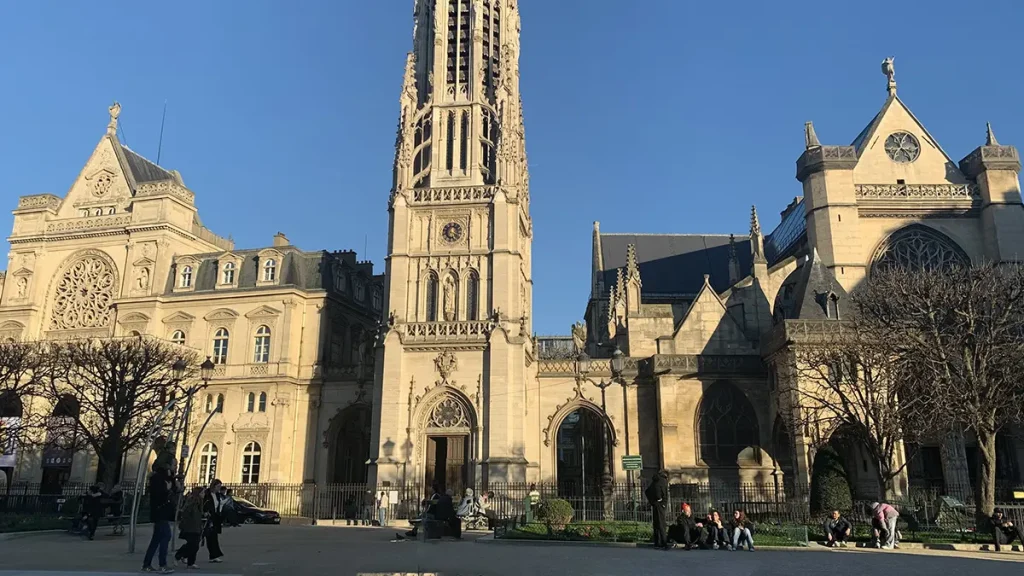
Between the church and the City Hall of the 1st arrondissement stands an imposing bell tower. While its neo-Gothic silhouette seems to harmonize perfectly with the church, it hides a dramatic secret. This is where the famous bell “Marie” is located.
During the night of August 23 to 24, 1572, it was not the Palace’s chime that gave the signal for the St. Bartholomew’s Day massacre, but indeed that of Saint-Germain-l’Auxerrois. This fatal tolling, intended to trigger the attack against Protestant leaders, marked the beginning of one of the darkest chapters in French history: a slaughter that left approximately 3,000 dead in Paris within a few days, and up to 30,000 throughout the kingdom. The striking contrast between the current serenity of the square and the violence of this historical event gives the neighborhood a unique depth.
Gemini a dit
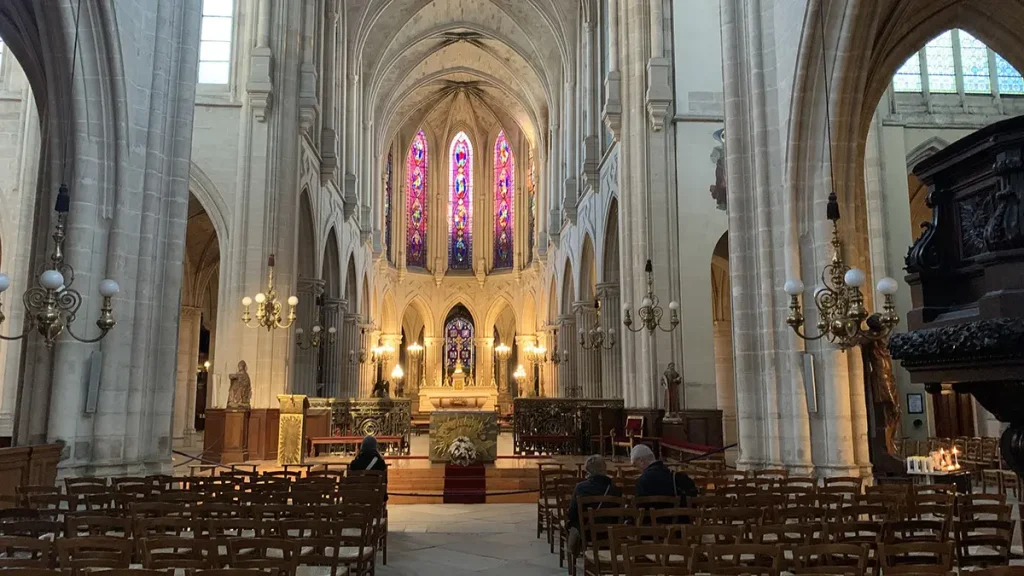
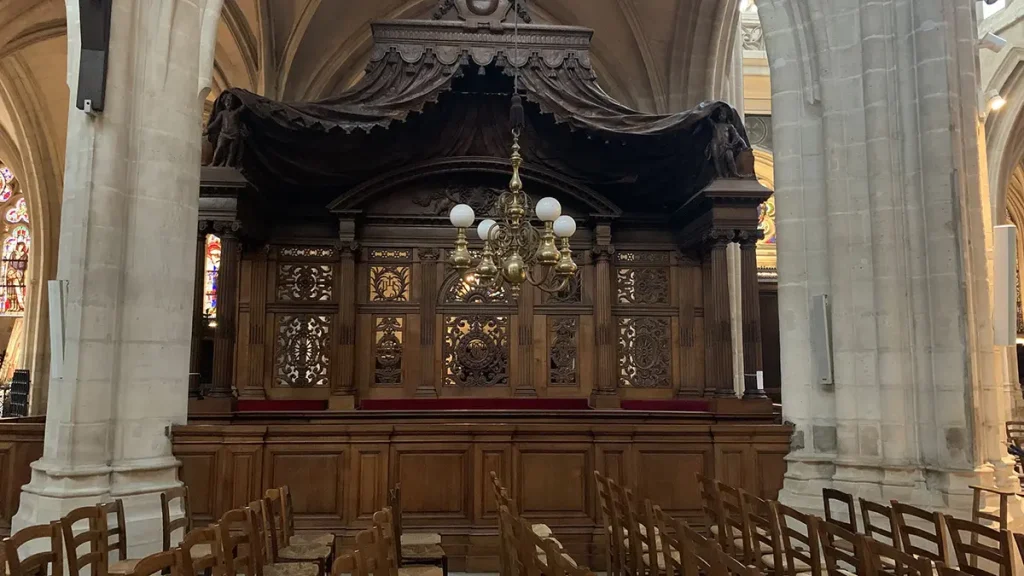
Once across the threshold, the eye is guided by the clarity of the vaults and a play of light that highlights the perspective of the nave. One can pause at the 1684 Banc d’œuvre. Designed by Charles Le Brun, Louis XIV’s first painter, this masterpiece of cabinet-making is what remains of the sovereign’s physical presence in the church. It was here that the Sun King and the Court sat for mass during their stays at the Louvre. The absence of paintings illustrating these moments underlines the almost private nature of this royal parish.
Before leaving, the visitor should linger in the side chapels. Saint-Germain-l’Auxerrois is the sanctuary of the artists who shaped the Louvre and Versailles. The architect Louis Le Vau, builder of Versailles and the Louvre colonnade; the painters Boucher and Chardin, whose masterpieces are gems in the world’s greatest museums; and the sculptor Antoine Coysevox, creator of the monumental statues in the Sun King’s gardens, all rest here.
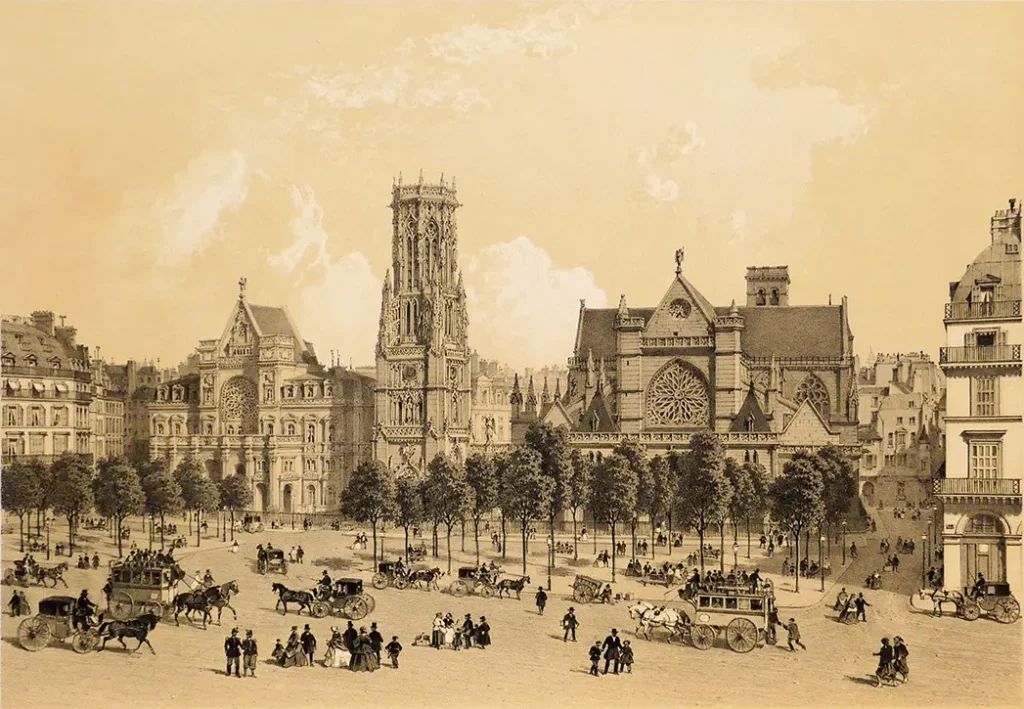
Upon leaving the church, one is struck by the dialogue between two architectures that seem to answer one another. This is one of the fascinating urban secrets of the neighborhood, born from Baron Haussmann’s desire to create a prestigious axis toward the Louvre colonnade.
To complement the medieval church, the architect Jacques Hittorff designed the City Hall of the 1st arrondissement by adopting the Gothic canons of Saint-Germain-l’Auxerrois. The bell tower, erected between the two buildings, serves as the pivot for this theatrical Second Empire staging. For a guest at Relais du Louvre, this panorama bears witness to an era when Paris reinvented itself with symmetrical elegance.
Today, the tumult of carriages has given way to strolling, but the soul of this royal crossroads remains intact. By returning to Relais du Louvre, you re-enter a piece of old Paris that has defied time and Haussmann’s construction sites. From your window, the church reminds you that you are part of a lineage of travelers who, for centuries, have found refuge in the shadow of Saint-Germain-l’Auxerrois. The history of France is no longer in books: it is there, right before your eyes.
Learn more about the history of Relais du Louvre: https://www.relaisdulouvre.com/en/history-relais-du-louvre-paris/